


Beard Transplants for Scarring: Restoring Hair After Injury or Surgery
Beard Transplants for Scarring: Restoring Hair After Injury or Surgery

Beard Transplants for Scarring: Restoring Hair After Injury or Surgery
Facial scarring can affect beard growth in ways that are difficult to address through any means other than surgery. Whether the scarring is the result of acne, an accident, a burn, or a surgical procedure, the damage to the underlying follicles can leave permanent gaps in the beard that no topical treatment or grooming technique can disguise effectively. For men in this situation, a beard transplant offers a genuine solution, one that addresses the root cause of the problem by introducing new, healthy follicles directly into the affected area.
This article explains how beard transplants work for men with facial scarring, what makes the procedure more technically demanding in these cases, and what results are realistically achievable depending on the nature and extent of the scarring involved.
“Scar tissue does not automatically rule out a beard transplant. The key is understanding the quality of the skin, the blood supply available, and creating a realistic plan that works with the tissue rather than against it.”
Darryl King, Hair Transplant Consultant
Why Scarring Affects Beard Growth
To understand how a beard transplant addresses scarring, it helps to understand why scarring prevents hair growth in the first place.
When the skin is damaged by injury, burns, surgery, or severe acne, the body repairs the wound by producing collagen. This repair process is efficient in terms of closing the wound and restoring the skin’s protective function, but it does not replicate the complex structure of healthy skin. Scar tissue lacks the hair follicles, sebaceous glands, and other structures that are present in normal skin. Where follicles existed before the injury, they are often destroyed in the scarring process and do not regenerate naturally.
The result is an area of skin that is smooth, sometimes tight or discoloured, and entirely without hair growth. In the beard area, this can leave a clearly visible gap that disrupts the otherwise natural pattern of facial hair, drawing attention to the scar and making it difficult to grow a beard that looks consistent across the face.
The extent of follicle loss depends on the depth and severity of the original injury. Superficial scarring that affects only the upper layers of the skin may leave some follicles intact, while deeper scarring that penetrates to the level of the dermis is more likely to have caused permanent follicle loss. This is one of the reasons why a thorough assessment of the scar tissue is such an important part of the consultation process for any patient considering a beard transplant for scarring.
The Most Common Causes of Scarring That Affect Beard Growth
Scarring that disrupts beard growth can arise from a number of different causes, each with its own characteristics and implications for treatment.
Acne scarring is by far the most common cause seen in patients seeking beard transplants for scarring. Severe or cystic acne can cause significant damage to the deeper layers of the skin, leaving behind pitted, uneven, or hypertrophic scars that destroy the follicles in affected areas. The scarring from acne often affects the cheeks and jawline, which are also key areas of the beard, making the disruption to facial hair growth particularly noticeable.
Surgical scarring is another common cause. Procedures such as facelifts, jaw surgery, cleft lip repair, or the removal of cysts and lesions can all leave scars in the beard area that disrupt hair growth. In some cases, the scarring is relatively fine and localised. In others, particularly where the original procedure was more extensive, the affected area can be larger and more complex to treat.
Burn scarring presents some of the most challenging cases in beard restoration. Burns can cause extensive damage to the skin and underlying tissue, and the resulting scar tissue is often significantly different in structure and blood supply to normal skin. The depth and extent of a burn scar, and the nature of any grafting or reconstructive surgery that has been performed to treat it, all affect the approach taken and the outcomes that can be expected from a beard transplant.
Traumatic scarring from accidents, sports injuries, or other physical trauma can affect the beard area in a variety of ways. Cuts, abrasions, and impact injuries can all leave scars that disrupt follicle growth, and the pattern of disruption depends on the nature and location of the original injury.
Cleft lip and palate repair can leave scarring in the upper lip area that affects moustache growth. For men who have undergone this surgery and want to restore more natural facial hair coverage in the affected area, a targeted transplant can produce meaningful improvements, though the scar tissue in this area can present specific challenges that require careful surgical assessment.
“For many patients, the goal is not perfection. It is restoring natural beard coverage in a way that makes the scar far less noticeable and helps them feel more confident about their appearance.”
Steven Ambrose, Hair Transplant Consultant
What Makes Transplanting into Scar Tissue More Challenging?
Transplanting hair follicles into scar tissue is technically more demanding than transplanting into healthy skin, and it is important to understand why this is the case.
The primary challenge is blood supply. Healthy skin has a rich network of blood vessels that support the survival and growth of transplanted follicles. Scar tissue, particularly deeper or more mature scars, typically has a reduced and less organised blood supply. Because transplanted follicles depend on an adequate blood supply to establish themselves and begin producing hair, the reduced vascularity of scar tissue means that graft survival rates can be lower than in normal skin.
The structure of scar tissue also differs from that of healthy skin. It is denser, less pliable, and can be more difficult to create recipient sites in without causing additional trauma. The surface of the scar may be uneven or irregular, which adds complexity to the process of placing grafts at the correct angle and depth.
These challenges do not make the procedure impossible, but they do mean that the surgeon’s experience and technique are particularly important when working with scar tissue. At Capital Hair Restoration, our GMC-registered surgeons have extensive experience in beard restoration for patients with scarring, and the additional care required in these cases is fully reflected in the way we approach the surgical planning and execution.
What Results Can You Expect from a Beard Transplant on Scar Tissue?
Managing expectations for beard transplants on scar tissue requires a more nuanced conversation than for straightforward beard restoration. The results achievable depend on a number of factors that vary considerably from one patient to the next, and honesty about this is an essential part of responsible practice.
The age and maturity of the scar is one of the most important factors. Fresh scars are generally not suitable for immediate transplantation. The skin needs time to heal fully and stabilise before it can support transplanted follicles. Most surgeons recommend waiting at least twelve months after the original injury or surgery before considering a transplant, and in some cases a longer wait may be advisable. Mature, well-healed scars typically provide a more stable environment for transplantation than recently formed ones.
The depth and extent of the scarring also has a significant bearing on the outcome. Shallow or superficial scars that have not destroyed the deeper layers of the skin tend to respond better to transplantation than deep or extensive scars where the tissue damage is more severe. In cases of deep scarring, the blood supply may be sufficiently compromised that graft survival is unpredictable, and a staged approach, starting with a smaller test area before committing to a full procedure, may be recommended.
The location of the scar on the face matters too. Scars in areas of the face where the skin is naturally more mobile, such as around the mouth and chin, can present additional challenges because the movement of the skin during normal facial expressions can place stress on newly transplanted grafts during the healing period.
With all of these variables in mind, it is important to understand that a beard transplant on scar tissue may not achieve the same density or predictability of result as a transplant on healthy skin. However, even a partial improvement can make a meaningful difference to the appearance of a scar and to the patient’s confidence. For many men, the goal is not perfection but meaningful camouflage, and this is often very achievable.
“Every scar tells a different story. Whether the cause is acne, surgery, or injury, a thorough assessment allows us to determine what can realistically be achieved and how best to approach the restoration.”
Darryl King, Hair Transplant Consultant
How the Procedure Is Approached for Scarring Cases
The surgical approach for a beard transplant on scar tissue follows the same fundamental FUE technique as for other beard transplants, but with several important modifications driven by the challenges of working with compromised skin.
Pre-procedure planning is more detailed in scarring cases. The surgeon will assess the scar tissue carefully, evaluating its depth, vascularity, and structure to determine how many grafts can realistically be placed and at what density. In some cases, particularly for extensive burn scarring or deep surgical scars, a test procedure may be recommended before a full transplant is planned. This involves placing a small number of grafts in a defined area of the scar to assess how well the tissue supports graft survival before committing to a larger procedure.
During the procedure itself, the surgeon takes particular care with the depth and angle of recipient site creation in scar tissue. The denser, less pliable nature of the tissue requires a more considered approach to avoid causing unnecessary trauma while still creating sites that allow grafts to be placed at natural angles.
Recovery and Results Timeline for Scarring Cases
Recovery from a beard transplant on scar tissue follows the same broad pattern as recovery from a standard beard transplant, but with a few additional considerations that patients should be aware of.
In the first few days after the procedure, redness and swelling in the treated area is normal and expected. Small scabs will form around each graft site and should be left to heal naturally without picking or disturbance. The healing process in scar tissue can sometimes take slightly longer than in healthy skin, and patients should not be alarmed if the initial recovery appears a little slower than the standard timeline would suggest.
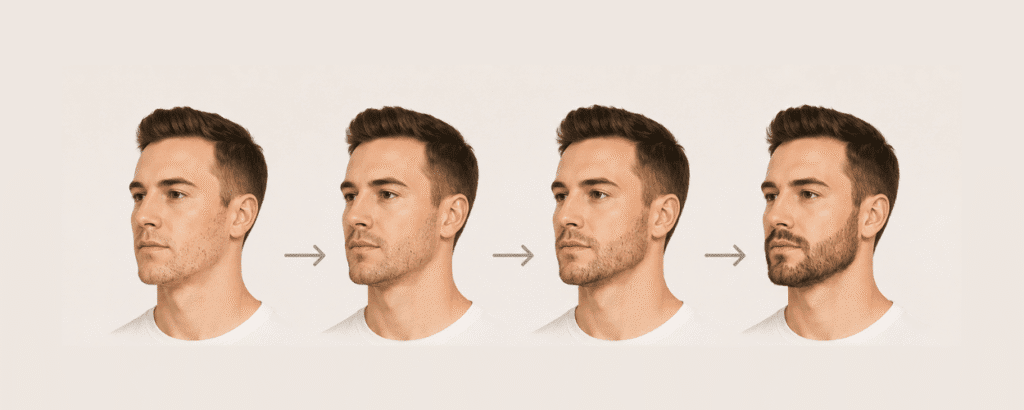
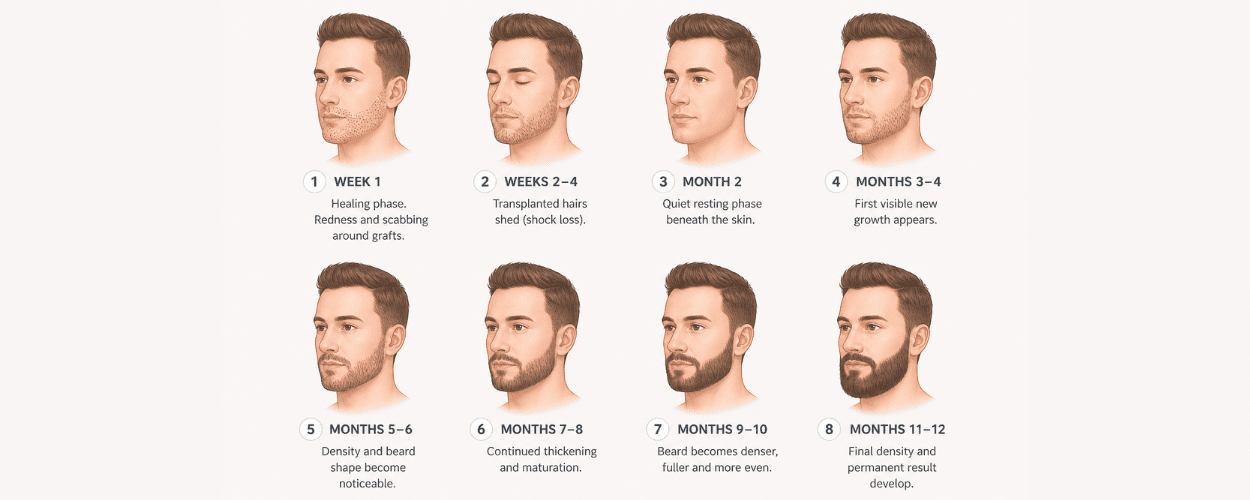
The transplanted hairs will shed from around two to four weeks post-procedure. As with any beard transplant, this is entirely normal and does not mean the grafts have failed. The follicles remain beneath the skin and will begin producing new growth from around three to four months.
For scarring cases specifically, the results timeline can sometimes be slightly extended compared to a standard beard transplant. The reduced blood supply in scar tissue means that the follicles may take a little longer to fully establish themselves, and the early growth that emerges at the three to four month mark may be finer and slower to thicken than in a transplant on healthy skin. Patients should allow the full twelve months, and in some cases a little beyond, before drawing any firm conclusions about the final outcome.
It is also worth noting that in scarring cases, the density achieved in the first procedure may be somewhat lower than initially hoped, particularly in areas of deeper or more extensive scarring. If this is the case, a second procedure after the first has fully matured may be considered to add further density. This is always discussed as part of the original planning process rather than presented as an unexpected development.
Acne Scarring: The Most Common Presentation
Because acne scarring is by far the most frequently seen cause of beard disruption in patients seeking scar-related beard transplants, it is worth addressing in a little more detail.
Acne scarring in the beard area typically presents as a combination of pitted or atrophic scars, where tissue has been lost and the skin surface is depressed, and hypertrophic or raised scars, where excess collagen has been produced during healing. Both types can disrupt follicle growth, though the degree of disruption varies.
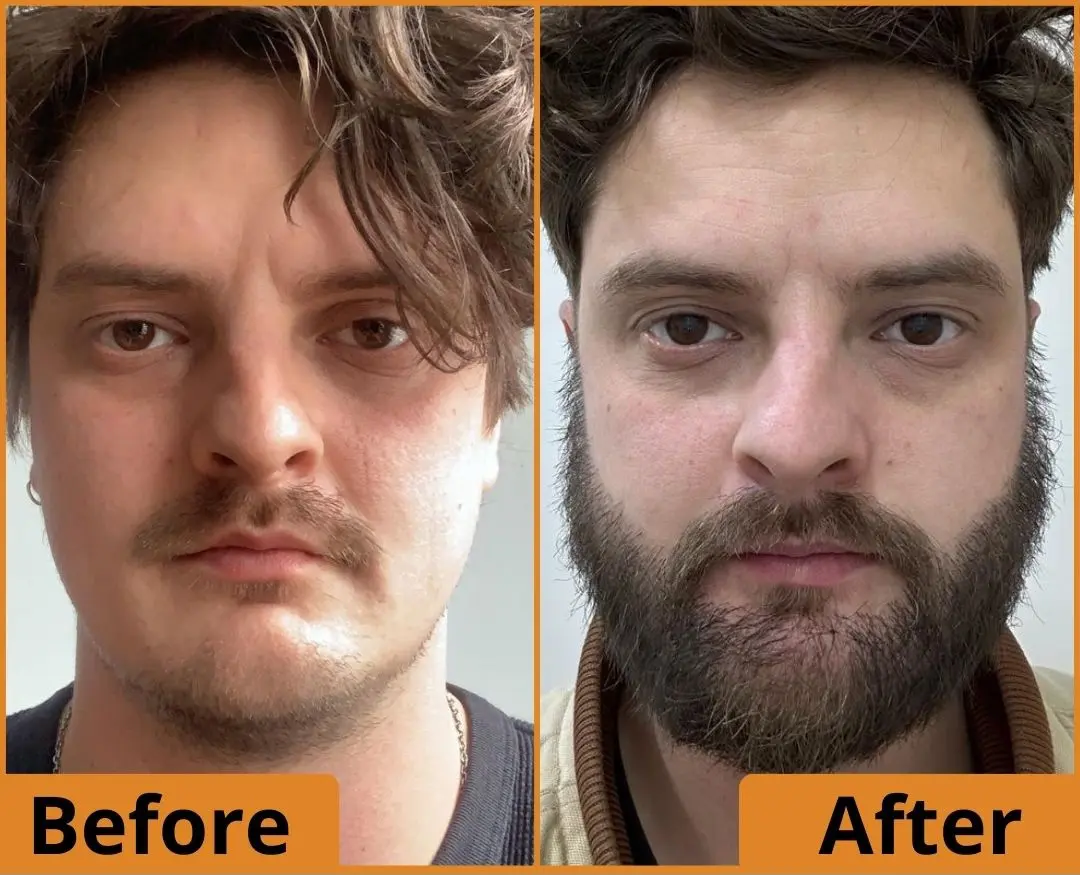
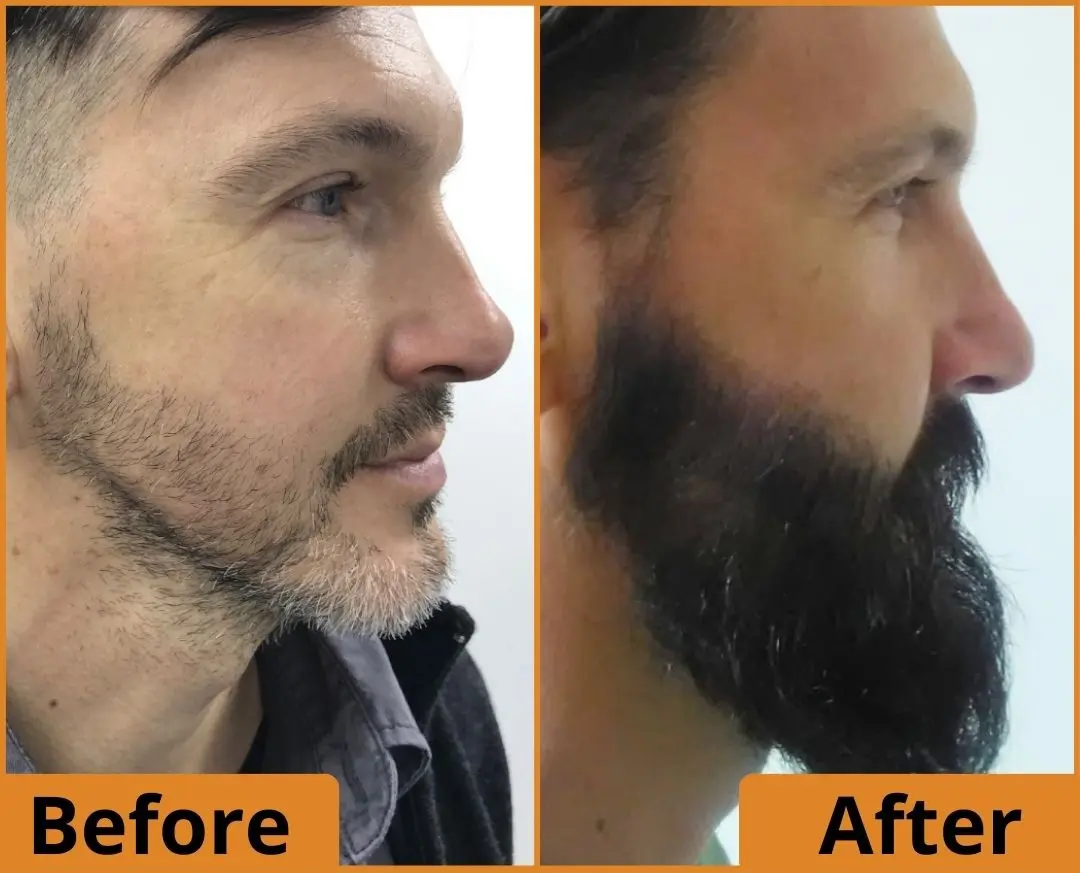
For patients with acne scarring, a beard transplant can produce genuinely impressive results, particularly where the scarring is shallow to moderate in depth. The transplanted hair grows through the scarred skin and, as it matures, helps to camouflage the texture and appearance of the underlying scar as well as restoring the missing hair coverage. Many patients find that the overall appearance of the scarred area improves significantly once the transplanted hair has fully grown, both in terms of beard coverage and in terms of how noticeable the scar itself appears.
For patients with deeper or more extensive acne scarring, the results are still meaningful but may require a more staged approach, with realistic expectations about the density achievable in each session.
Questions to Ask at Your Consultation if You Have Facial Scarring
Going into a consultation with facial scarring requires a specific set of questions to make sure you get the most accurate picture of what is achievable in your individual case. The following are worth raising:
- How mature does my scar need to be before a transplant is appropriate?
- How does the depth and type of my scarring affect the likely graft survival rate?
- Would you recommend a test procedure before committing to a full transplant?
- What density can I realistically expect in the scarred area?
- How does the result in the scarred area compare to what would be achievable in healthy skin?
- Is a staged approach likely to be needed, and if so what would that involve?
- What does the aftercare process look like for a scarring case specifically?
A surgeon who answers these questions with clarity and honesty, without overpromising or dismissing the complexity of your case, is one who can be trusted to give you the best possible outcome.
Is a Beard Transplant for Scarring Right for You?
For men with facial scarring that has disrupted beard growth, a beard transplant is often the only genuinely effective solution available. Non-surgical approaches cannot restore hair growth where follicles have been permanently destroyed, and grooming techniques can only disguise the issue to a limited degree. A well-planned and well-executed beard transplant, even on challenging scar tissue, can produce results that meaningfully improve both the appearance of the scar and the coverage of the beard.
The key is choosing a clinic with the experience and expertise to handle the additional complexity that scarring cases involve. Not all beard transplant surgeons have extensive experience working with scar tissue, and this is an area where the surgeon’s skill and case history make a particularly significant difference to the outcome.
At Capital Hair Restoration, our GMC-registered surgeons have significant experience in beard restoration for patients with all types of facial scarring. We approach every scarring case with the additional care, planning, and honesty that it requires, and we will always give you a clear and realistic picture of what we can achieve before you make any decisions.
Book a Beard Transplant Consultation
Facial scarring can have a significant impact on beard growth, but it does not automatically mean those areas must remain hairless permanently. For many men, a beard transplant provides an effective way to restore natural facial hair growth, reduce the visibility of scars, and improve overall facial symmetry and confidence.
Transplanting into scar tissue is more complex than a standard beard transplant, and results depend on factors such as the age of the scar, its depth, blood supply, and the condition of the surrounding skin. However, with careful planning and realistic expectations, meaningful improvements are often achievable, even in cases involving significant scarring from acne, surgery, burns, or injury.
The most important step is obtaining an honest assessment from an experienced surgeon. Every scar is different, and the right approach for one patient may not be appropriate for another. A detailed consultation allows the scar tissue, donor area, and beard goals to be assessed together so that a personalised treatment plan can be created.
If you are considering a beard transplant for facial scarring, Capital Hair Restoration offers consultations across the UK, including Brentwood, Bristol, Bromley, Chelmsford, Ipswich, Milton Keynes, Oxford and Tunbridge Wells.
At Capital Hair Restoration, consultations focus on scar assessment, donor area evaluation, graft planning, expected density, recovery timelines, and realistic long-term outcomes. Our experienced team will explain your options clearly and help you understand exactly what can be achieved in your individual case.
Book your consultation today and take the first step towards restoring natural beard growth and reducing the appearance of facial scarring.


Book Your Free Hair Transplant Consultation
Fill in your details and we'll get in touch with you shortly.